There’s a conversation happening in firms across the country, quietly, over coffee and in conference rooms after long project meetings.
It goes something like this: “When did this job stop being about the work and start being about the people?”
If you’ve asked yourself that question, you’re in good company.
Architecture, interior design, land surveying — these are technical disciplines. We go to school for the craft. We learn how to draw, design, survey, model, and deliver. We build our early careers on execution.
And then, somewhere along the way, the real job begins. And nobody prepared us for it.
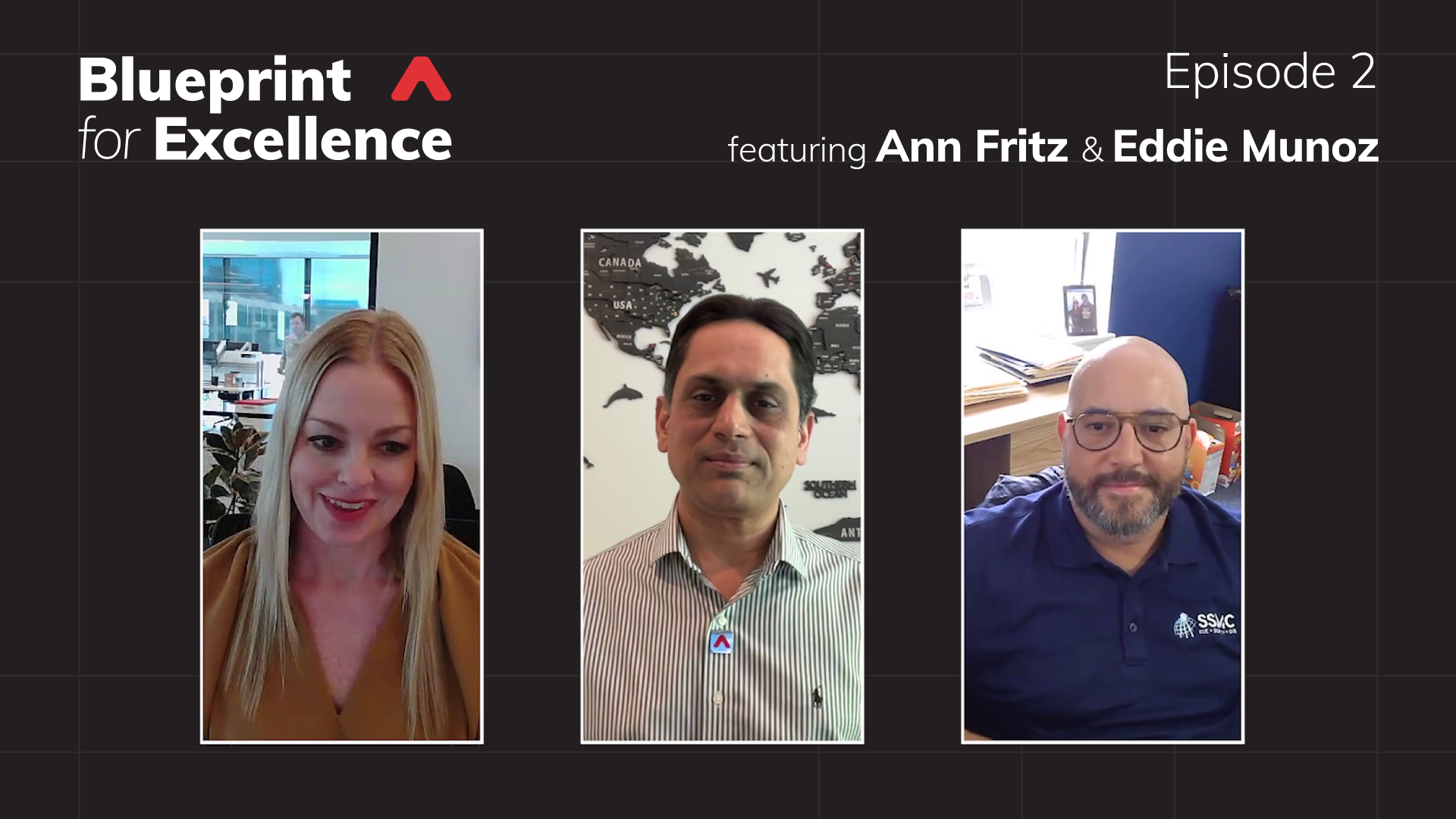
For Episode 2 of Blueprint for Excellence, I sat down with two leaders who know exactly what that transition feels like — and who have come out the other side with hard-won perspective worth sharing.
Ann Fritz is a Managing Principal at ESG Architecture and Design, where she leads a 35-person interior design team as part of a 120-person firm. She started as an intern, survived a recession that took the firm from 97 people down to 21, and rebuilt from scratch.
Eddie Munoz is the Director of Land Development and Vice President for the Central Florida division at Southeastern Surveying and Mapping. He came in as a survey technician, earned his professional license in 2020, and was thrust into leadership when most of the senior licensed surveyors at his office retired at once.
Listen to the Full Episode
Episode 2 of Blueprint for Excellence is live now. Hear Ann and Eddie tell their stories in their own words — the early struggles, the moments of doubt, and the mindset shifts that changed everything.
You can also listen to the audio version below.
Two different industries. Two different paths. The same core leadership lessons.
I asked Ann about the biggest challenges she faces today as a leader. Her answer was immediate.
People.
Not budgets. Not project timelines. Not clients. People.
Managing personalities. Pairing the right team members on the right projects. Understanding who needs direct feedback, who needs space, and who needs someone to sit with them and talk it through.
“I feel like I’m a therapist more than a boss sometimes,” she told me. And she meant it without complaint — she said people are also what she loves most about the work.
Eddie echoed it. He called it the “Dr. Phil hat” — the ability to read where someone is coming from on a given day, and to adjust how you approach them accordingly. The way you motivate John isn’t the way you motivate Jane, even when the task is identical.
Here’s what struck me about both of them: neither said they were taught any of this. You don’t learn it in design school. You don’t learn it in a drafting program. You learn it by doing it — often imperfectly, often under pressure, often without a guide.
That gap is real. And it’s costing our industry.
Thrown Into the Fire
Both Ann and Eddie described being pushed into leadership not by design, but by circumstance.
For Ann, the recession cleared the path. When her firm shrank from nearly 100 people to 21, she was the one left standing in interior design. There was no formal handoff. No leadership development program. She just had to figure it out — while keeping clients happy and building a new team from almost nothing.
For Eddie, it was a wave of retirements. Senior licensed surveyors left within the same short window, and Eddie — still growing professionally himself — had to step in and hold the operation together. Projects didn’t pause. Clients didn’t lower their expectations. The work kept coming.
“It was more like, ‘Okay, we’re gone. Go ahead and you take it from here,'” Eddie said.
What carried both of them through wasn’t a playbook. It was ownership.
At some point, you stop asking if you’re ready and you decide: I’m the one here. This has to get done. I’m going to make it work.
That decision — the moment you fully take ownership — is often the moment leadership actually begins.
The Hardest Part of Growing: Letting Go
One of the most honest things Ann said in our conversation was about the transition from doing to leading.
When you’ve spent years executing — when you know how to do the work, and you know how to do it well — it is genuinely hard to step back and let someone else do it. Even when they’re capable. Even when that’s exactly what needs to happen for the team to grow.
“When I was so used to doing all the work myself, now I was delegating more of the work or overseeing it, and it’s hard to not get in there and just fix it.”
She was describing something I’ve seen in every technical discipline I’ve worked with over 20 years: the shift from influencing through doing to influencing through others. It doesn’t happen overnight. And you have to give yourself permission to be imperfect at it while you’re learning.
Ann’s approach to hiring helped her navigate this. Instead of training junior people up slowly, she deliberately went after people who were more experienced, more seasoned, sometimes better in their craft than she was. She didn’t care. She wanted the work done well, and she knew the most important thing she could offer was culture, context, and clarity.
“I look for the DNA or the spirit of the person,” she said. “The rest we can teach.”
Key Lessons From Ann and Eddie
Here’s what I took from this conversation:
- Will over skill — every time. Ann puts culture fit above credentials in hiring. Eddie screens for energy and attitude as much as technical ability. The best resume in the world means nothing if the person disrupts the culture you’ve worked hard to build. You can teach skills. You can’t teach the will to do good work.
- Ownership is the turning point. Both Ann and Eddie described a moment when imposter syndrome gave way to something more durable. It happened when they stopped asking “Am I the right person for this?” and started asking “What does this situation need from me?” That shift — from doubt to ownership — changes everything.
- Communicate differently with different people. Eddie’s “Dr. Phil hat” isn’t soft. It’s strategic. Knowing how to approach each person on your team — what motivates them, how they learn, what kind of feedback they respond to — is what separates managers from leaders. It’s also what builds trust. And trust is the only real currency in a services business.
- Building a great team means building your own replacement. Eddie is intentional about this: he is actively grooming the people who will eventually take his seat. Not because he’s going anywhere, but because that’s what good leadership looks like. You’re not here to be indispensable. You’re here to make the people around you capable and confident.
- The problems that seem external are often internal. Ann talked about tariffs slowing projects, inconsistent workloads, and the pressure of keeping 110 people productive and engaged. These feel like market problems. But the way you navigate them is a leadership problem. Clear communication, flexible planning, and strong team relationships are what get firms through volatility — not just market conditions.
What I Would Tell My Younger Self
I asked both Ann and Eddie the same question: if you could go back and advise your younger self, what would you say?
Eddie’s answer: Trust the process. Stop second-guessing every decision. The experience you’re gaining — even in the hard moments, especially in the hard moments — is building something. Be present in it. Let it accumulate.
Ann’s answer surprised me a little, and it stayed with me. She said she’d give herself more grace. Work harder at setting boundaries. Not be afraid to ask for help.
She also shared the best piece of career advice I’ve heard in a long time — something someone had told her recently that she couldn’t stop thinking about:
“The way to move ahead or get promoted is to think about what you could do to make your boss’s job easier.”
That’s it. That’s the whole framework. Your boss is your customer. Show up with solutions, not just problems. Anticipate what’s needed before it’s asked for. Think one level above where you are right now. Do that consistently, and you will be noticed.
Eddie added one more layer: be present in the small moments. The daily tasks that feel routine are where opportunities hide. Step up before you’re asked. Make the decision. Own it. That’s leading by example — and you don’t have to have a title to do it.
A Closing Thought
After 20 years of working with engineering and architecture firms, here’s what I keep coming back to: the firms that grow well aren’t just technically excellent. They’re filled with people who’ve made peace with the fact that leadership is people work — and who’ve invested in getting better at it.
Ann and Eddie didn’t get formal training. They got experience, pressure, and enough self-awareness to learn from both. The industry doesn’t hand you a leadership manual. You have to write it yourself, one hard lesson at a time.
But here’s the good news: you don’t have to figure it out alone.
That’s exactly why I created Blueprint for Excellence — to bring these real, unpolished leadership stories out into the open, so that the next generation of leaders can get further, faster.
Sandesh Joshi is the Founder and CEO of Indovance Inc., a global engineering outsourcing services company. He has spent more than 20 years partnering with engineering and architectural leaders across North America.