There’s a question every founder eventually has to sit with, whether they want to or not: what happens to this company if I’m not in the room anymore?
Most of us don’t ask it early enough. We’re too busy building — winning the next project, hiring the next hire, keeping the lights on. Then one day someone, a buyer, a partner, a mirror, asks what the business is actually worth without you standing next to it.
That question is uncomfortable. It’s also the whole game.
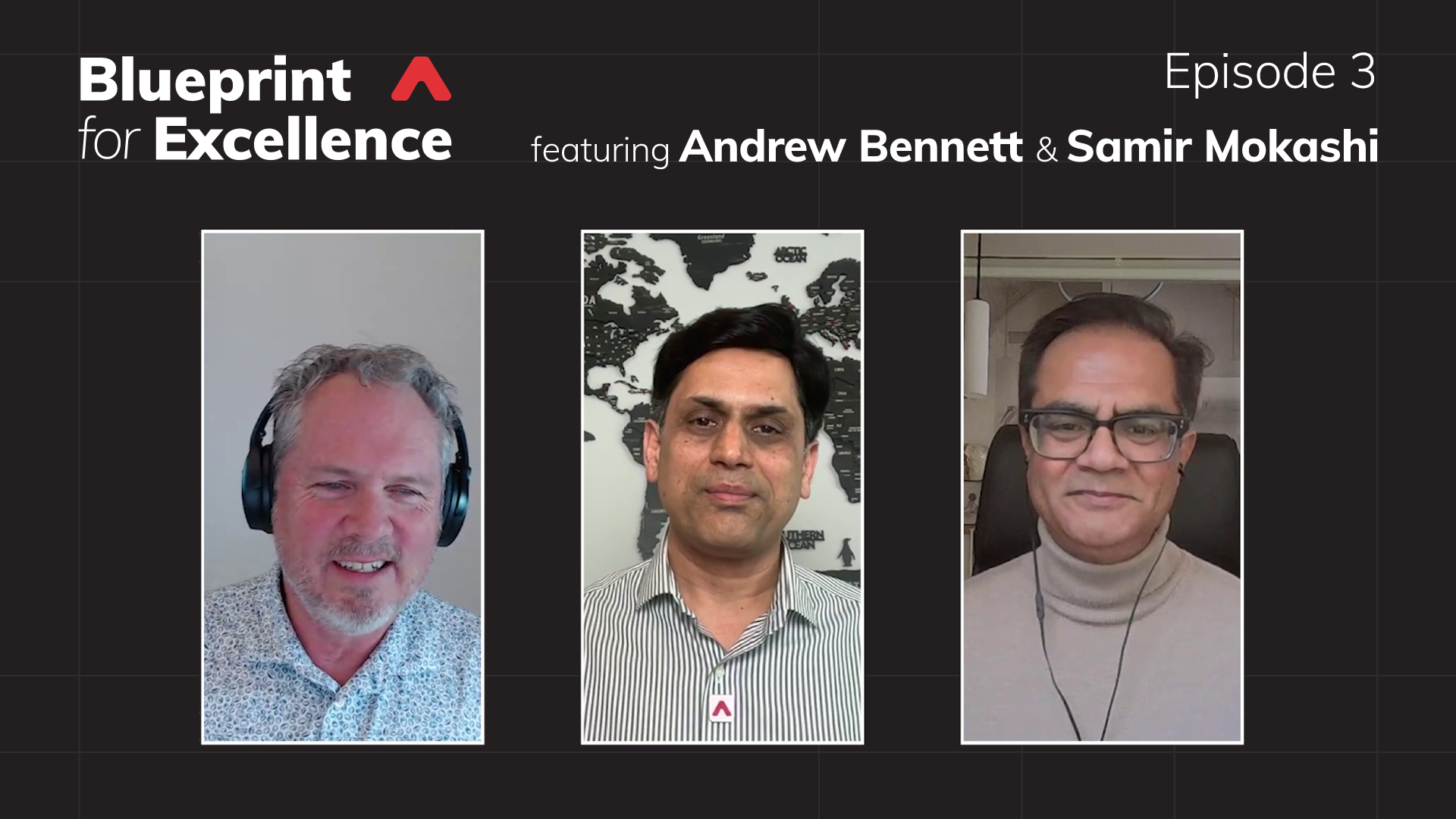
For Episode 3 of Blueprint for Excellence, I sat down with two guests who’ve spent their careers on opposite sides of that question. Andrew Bennett is a Partner and Principal at BOKA Powell, a 70-person, 50-year-old architecture and design firm in Dallas, Texas, that’s currently juggling three landmark projects worth a combined three-quarters of a billion dollars. Samir Mokashi is a business strategist, author of The Millionaire Exit, and the founder of Code Unlimited, a code consulting firm he built with his wife and sold in 2022. Today he mentors architecture and engineering firm owners — including several in India — on how to build something a buyer would actually want.
Between the two of them, I got a masterclass in a topic every leader needs to think about far sooner than they usually do: how do you build value into your business — real, transferable, sellable value — instead of just building a job for yourself?
Listen to the Full Episode
Andrew and Samir were generous, direct, and — as you’ll hear — genuinely enjoyed sparking off each other’s perspectives from two very different corners of the industry. If you’re a founder, partner, or principal thinking about what your firm is really worth, or wondering how to build something that can grow beyond you, this episode of Blueprint for Excellence is worth your time. Listen wherever you get your podcasts or watch the full conversation on our YouTube channel — and if it resonates, pass it along to a colleague who’s asking themselves the same question.
The Leadership Challenge: You Are the Bottleneck
Samir said something early in our conversation that I haven’t stopped thinking about.
The firms he works with — typically doing $1 million to $10 million in revenue — almost all share the same problem. The owner is the bottleneck. Every decision, every client relationship, every “what do we do next” eventually lands back on their desk.
“They say, ‘Oh, I delegate,'” Samir told me, “but they all come back to him or her asking them what next, right?”
That’s not delegation. That’s the illusion of delegation. And it’s the single biggest thing standing between a good business and a valuable one.
Here’s why it matters so much: a buyer isn’t purchasing your hustle. They’re purchasing a system that keeps working after you leave the building. If the firm can’t function without you, you haven’t built a business — you’ve built a very demanding job.
See Your Firm the Way a Buyer Would
Samir’s core insight on valuation is deceptively simple: stop looking at your firm from the inside.
“We all see our firm from our side and say, ‘Oh, look at all the things I’m doing,'” he said. “But you go to a supermarket, and you don’t buy everything that’s on the shelf either, right?”
A buyer isn’t impressed by your effort. They’re evaluating risk. Can this firm run without the founder’s personal Rolodex? Are roles clearly defined, or does everybody do everything because that’s how a small shop stays flexible? What breaks when key people leave?
That last question hits hardest in professional services. Samir pointed out that in small firms, “everybody does everything,” which works fine at ten people. It becomes chaos the moment a larger buyer — or a larger competitor — shows up expecting structure.
The fix, in Samir’s words, comes down to systems. Clear roles. Defined processes. Documentation that doesn’t live only in one person’s head. Boring stuff. It’s also exactly what turns a personality-driven shop into an asset someone else would want to own.
Business Development Can’t Live in One Person’s Head Either
The second half of the value equation is harder for most founders to hear: your client relationships have to outlive your involvement in them.
Samir described it plainly — when you start out, business development is personal. People hire you because they like you. That’s normal early on. But if the firm still runs entirely on the founder’s relationships ten or twenty years in, there’s no business to sell. There’s just a book of contacts.
“When you walk away from the firm, do you leave with all the clients, all the relationships, everything is gone?” he asked. “How do you transition that and still trust the people to do the things they want to do?”
That’s a mindset shift, not a paperwork exercise. It means introducing your team to clients instead of shielding the relationship. It means tracking the numbers, too — Samir was refreshingly blunt: “I’m not gonna give you logarithms, just addition, subtraction. That’s all. It is really that simple.” Track what comes in and what goes out, diligently. Most founders resist this because the same stubbornness that got them through the startup years also convinces them they already know best.
Competing With Giants Without Becoming One
Andrew brought a different but complementary lens to the same theme: how do you protect the value you’ve built when the market keeps sending bigger competitors your way?
BOKA Powell just celebrated 50 years in business. And yet, as Andrew put it, “we are still seen as this local, regionalized, I dare say mom and pop firm.” Meanwhile, mega-firms with offices around the world and unlimited bench strength are moving into Dallas-Fort Worth and chasing projects they never used to bother with.
His answer isn’t to out-muscle them. It’s to out-maneuver them — through outsourcing partnerships that extend capacity without inflating overhead, and through early, aggressive adoption of technology. BOKA Powell was one of the first firms in Dallas to embrace 3D modeling back in the late ’80s. That early bet is exactly the kind of decision that compounds into durable value years later.
Andrew’s other advantage: he’s not afraid of AI. He’s already using it to speed up renderings, cross-check code compliance, and — through his son’s work at a partner engineering firm — capture institutional knowledge before retiring experts walk out the door with it in their heads. That connects directly to Samir’s point. Knowledge trapped in one person’s head is a liability. Captured and systematized, it becomes an asset the business owns — one that survives any single person’s departure, founder included.
Key Lessons From the Conversation
A few things stood out that I think every firm owner should sit with:
- Delegation isn’t real until decisions stop coming back to you. If your team still needs your sign-off on everything, you haven’t built leverage — you’ve built a longer to-do list for yourself.
- Think like the buyer, not the seller. Whether or not you ever plan to sell, running the exercise — what would a buyer question, doubt, or discount? — exposes the weak points in your business faster than almost anything else.
- Simplify your systems before you scale them. Andrew and Samir both described the same failure mode: roles that blur together work fine at a small scale and become chaos the moment the firm grows or a larger buyer takes a close look.
- Relationships need to belong to the firm, not the founder. If the business can’t survive your absence from a client meeting, that client relationship is a risk sitting on your balance sheet, not an asset.
- Your stubbornness got you here — and it can also get in your way. The same relentless self-belief that builds a firm from nothing can quietly convince a founder that no one else’s advice is worth hearing. Staying coachable is a leadership skill, not a weakness.
- Numbers don’t have to be complicated to be powerful. You don’t need advanced financial modeling to run a valuable business. You need discipline — tracking money in, money out, consistently, and asking good questions about what the numbers are telling you.
A Closing Thought
I’ve said this before on this podcast, and Andrew and Samir’s conversation only reinforced it: success isn’t an accident. Neither is building a company that’s worth something beyond the person who started it.
The founders who build lasting value aren’t necessarily the most talented designers or the sharpest technicians in the room. They’re the ones willing to ask the harder question early — not “how do I get more work,” but “how do I build something that doesn’t depend on me to keep working.” That’s a different kind of discipline. It’s less glamorous than winning the big project. But it’s the difference between building a career and building a company.
At Indovance, our tagline is “Let’s Grow Together.” Conversations like this one are exactly why that philosophy matters — growth that’s built to last has to be built into the structure of the firm, not just carried on the founder’s back.